Completed
Factorisation with Complex Numbers
Class Central Classrooms beta
YouTube videos curated by Class Central.
Classroom Contents
Using Complex Numbers - Comprehensive Course on De Moivre's Theorem, Argand Diagrams, and Complex Analysis
Automatically move to the next video in the Classroom when playback concludes
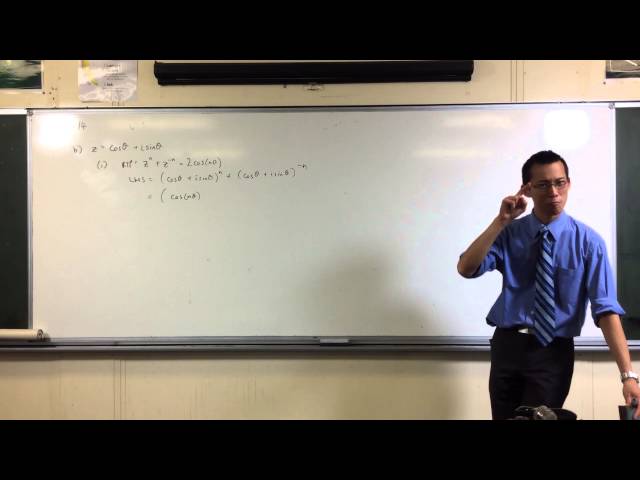
- 1 Using De Moivre's Theorem to Prove Trigonometric Identity
- 2 Understanding & Applying the Conjugate Root Theorem
- 3 Argand Diagram / Locus Question
- 4 Interesting Complex Polynomial Question (1 of 2: Factorisation)
- 5 Interesting Complex Polynomial Question (2 of 2: Trigonometric Result)
- 6 Complex Numbers as Points (1 of 4: Geometric Meaning of Addition)
- 7 Complex Numbers as Points (2 of 4: Geometric Meaning of Subtraction)
- 8 Complex Numbers as Points (3 of 4: Geometric Meaning of Multiplication)
- 9 Complex Numbers as Points (4 of 4: Second Multiplication Example)
- 10 De Moivre's Theorem
- 11 How to graph the locus of |z-1|=1
- 12 Complex Numbers as Vectors (1 of 3: Introduction & Addition)
- 13 Complex Numbers as Vectors (2 of 3: Subtraction)
- 14 Complex Numbers as Vectors (3 of 3: Using Geometric Properties)
- 15 Complex Roots (2 of 5: Expanding in Rectangular Form)
- 16 The Triangle Inequalities (1 of 3: Sum of Complex Numbers)
- 17 Graphs in the Complex Plane (1 of 4: Introductory Examples)
- 18 The Triangle Inequalities (2 of 3: Discussing Specific Cases)
- 19 The Triangle Inequalities (3 of 3: Difference of Complex Numbers)
- 20 Graphs in the Complex Plane (2 of 4: Graphing Complex Inequalities)
- 21 Graphs in the Complex Plane (3 of 4 : Shifting the Point of Reference)
- 22 Graphs in the Complex Plane (4 of 4: Where is the argument measured from?)
- 23 Further Graphs on the Complex Plane (1 of 3: Geometrical Representation of Moduli)
- 24 Further Graphs on the Complex Plane (2 of 3: Algebraically verifying Graphs concerning the Moduli)
- 25 Further Graphs on the Complex Plane (3 of 3: Geometrical Representation of Arguments)
- 26 Graphs on the Complex Plane (3 of 4: Geometry of arg(z)-arg(z-1))
- 27 Graphs on the Complex Plane (4 of 4: Exploring how the argument traced the graph)
- 28 Graphs on the Complex Plane [Continued] (1 of 4: What's behind the graph?)
- 29 Graphs on the Complex Plane [Continued] (2 of 4: Finding Regions of Inequality by Testing Points)
- 30 Using Inverse tan to find arguments? (1 of 2: Why it doesn't work... Sometimes)
- 31 Complex Roots (1 of 5: Introduction)
- 32 Complex Roots (3 of 5: Through Polar Form Using De Moivre's Theorem)
- 33 Using Inverse tan to find arguments? (2 of 2: Why it works... Sometimes)
- 34 Complex Roots (4 of 5: Through Polar Form Generating Solutions)
- 35 Complex Roots (5 of 5: Flowing Example - Solving z^6=64)
- 36 Complex Conjugate Root Theorem (1 of 4: Using DMT and Polar Form to solve for Complex Roots)
- 37 Complex Conjugate Root Theorem (2 of 4: Introduction to the Conjugate Root Theorem)
- 38 Complex Conjugate Root Theorem (3 of 4: Geometrical Shape represented by Conjugate Root Theorem)
- 39 Complex Conjugate Root Theorem (4 of 4: Using Factorisation to find patterns with Roots of Unity)
- 40 DMT and Trig Identities (1 of 4: Deriving multi-angle identities with compound angles)
- 41 DMT and Trig Identities (2 of 4: Using De Moivre's Theorem and Binomial Expansions)
- 42 DMT and Trig Identities (3 of 4: Deriving tan expression from cos and sin)
- 43 DMT and Trig Identities (4 of 4: Using Multi-angle formula to solve polynomials)
- 44 Complex Numbers (1 of 6: Solving Harder Complex Numbers Questions) [Student requested problem]
- 45 Complex Numbers (2 of 6: Solving Harder Complex Numbers Questions) [Student Requested Problem]
- 46 Complex Numbers (3 of 6: Harder Complex Numbers Question) [Student Requested Problem]
- 47 Complex Numbers (4 of 6: Harder Complex Numbers Questions) [Student Requested Problem]
- 48 Complex Numbers (5 of 6: Complex Numbers Proofs [Using the Conjugate])
- 49 Complex Numbers (6 of 6: Finishing off the Proof)
- 50 Roots and Coefficients (1 of 3: Using DMT & Binomial Theorem to find identities)
- 51 Roots and Coefficients (2 of 3: Using Trigonometry to solve polynomial problems)
- 52 Roots and Coefficients (3 of 3: Using the results to find a relation in cosine)
- 53 Extension II Assessment Review (5 of 5: De Moivre's Theorem and Polynomials)
- 54 Why Complex Numbers? (1 of 5: Atoms & Strings)
- 55 Why Complex Numbers? (2 of 5: Impossible Roots)
- 56 Why Complex Numbers? (3 of 5: The Imaginary Unit)
- 57 Why Complex Numbers? (4 of 5: Turning the key)
- 58 Why Complex Numbers? (5 of 5: Where to now?)
- 59 Complex Arithmetic (1 of 2: Addition, Subtraction & Multiplication)
- 60 Complex Arithmetic (2 of 2: Division)
- 61 Factorisation with Complex Numbers
- 62 Vectors (1 of 4: Outline of vectors and their ability to represent complex number)
- 63 Vectors (2 of 4: Representing addition & subtraction of complex numbers with vectors)
- 64 Vectors (3 of 4: Geometrically representing multiplication of complex numbers with vectors)
- 65 Vectors (4 of 4: Outlining the usefulness of vectors in representing geometry)
- 66 Curves and Regions on the Complex Plane (1 of 4: Introductory example plotting |z|=5 geometrically)
- 67 Curves and Regions on the Complex Plane (2 of 4: Deciphering terminology to plot complex numbers)
- 68 Curves and Regions on the Complex Plane (3 of 4: Simplifying expressions to plot on a complex plane)
- 69 Curves and Regions on the Complex Plane (4 of 4: Plotting simultaneous shifted complex numbers)
- 70 Further Curves and Regions (1 of 5: Why does Sine & the Sine Rule produce an ambiguous case?)
- 71 Further Curves and Regions (2 of 5: Finding the Range of |z| )
- 72 Further Curves and Regions (3 of 5: Finding the range of arg z)
- 73 Further Curves and Regions (4 of 5: Geometrical expression of expressions of arg)
- 74 Further Curves and Regions (5 of 5: Using Circle properties to graph an expression of args)
- 75 DMT & Complex Roots (1 of 4: Reviewing geometrical expression of arg equations)
- 76 DMT & Complex Roots (2 of 4: Using DMT to find roots of a complex polynomial)
- 77 DMT & Complex Roots (3 of 4: Using the fundamental theorem of algebra to justify number of roots)
- 78 DMT & Complex Roots (4 of 4: Solving for roots of a complex number taking advantage of DMT)
- 79 Complex Roots (1 of 5: Observing Complex Conjugate Root Theorem through seventh roots of unity)
- 80 Complex Roots (2 of 5: Using Trigonometrical Identities & Conjugates to solve an equation)
- 81 Complex Roots (3 of 5: Using DMT to solve an equation of roots of unity)
- 82 Complex Roots (4 of 5: Using Polynomial Identities to prove unity identities)
- 83 Complex Roots (5 of 5: Using Geometric Progression to find factors of ω^n - 1)
- 84 DMT and Trig Identities (1 of 4: Noticing a pattern in natural numbers)
- 85 DMT and Trig Identities (2 of 4: Using Trig expansion to find the sine triple angle formula)
- 86 DMT and Trig Identities (3 of 4: Using DMT and Polynomials to verify triple angle formula for sine)
- 87 DMT and Trig Identities (4 of 4: Using Trig Identities to solve polynomial equations)
- 88 HSC Question on Complex Numbers, Vectors & Triangle Area (1 of 2: Thinking geometrically)
- 89 HSC Question on Complex Numbers, Vectors & Triangle Area (2 of 2: Manipulating trigonometric terms)
- 90 HSC Question on Complex Numbers, Vectors & Polynomials (1 of 2: How to "explain")
- 91 HSC Question on Complex Numbers, Vectors & Polynomials (2 of 2: Combining results)
- 92 2016 HSC - Complex Numbers on Unit Circle (1 of 2: Considering Re & Im Parts)
- 93 2016 HSC - Complex Numbers on Unit Circle (2 of 2: Evaluating the arguments)
- 94 2016 HSC - Complex Identity Proof (1 of 3: Convert to polar form)
- 95 2016 HSC - Complex Identity Proof (2 of 3: Using binomial theorem)
- 96 2016 HSC - Complex Identity Proof (3 of 3: Combining results)
- 97 Semi Circles on Argand Diagrams (3 of 3: Oblique example)
- 98 Semi Circles on Argand Diagrams (2 of 3: Graphing the locus)
- 99 Semi Circles on Argand Diagrams (1 of 3: Relating the angles)
- 100 Algebraic Proof for Opposing Rays (3 of 3: Testing cases)
- 101 Algebraic Proof for Opposing Rays (2 of 3: Generating the equation)
- 102 Algebraic Proof for Opposing Rays (1 of 3: Foundational knowledge)
- 103 cos⁴θ Identity
- 104 Graphs in the Complex Plane (3 of 3: Opposing rays)
- 105 Graphs in the Complex Plane (2 of 3: Algebraic method)
- 106 Graphs in the Complex Plane (1 of 3: Perpendicular bisector - visual method)
- 107 Complex Polynomial Identity Question (4 of 4: Roots & coefficients)
- 108 Complex Polynomial Identity Question (3 of 4: de Moivre's Theorem)
- 109 Complex Polynomial Identity Question (2 of 4: Difference of cubes)
- 110 Complex Polynomial Identity Question (1 of 4: Quadratic factors)
- 111 Sum & Product of Cosines (3 of 3: Drawing ℝ conclusions)
- 112 Sum & Product of Cosines (2 of 3: Simplifying with conjugates)
- 113 Sum & Product of Cosines (1 of 3: 9th roots of unity)
- 114 Nth Roots of a ℂ Number (2 of 2: Example problem)
- 115 Nth Roots of a ℂ Number (1 of 2: General form)
- 116 Roots of Unity (2 of 2: Insights from polar & exponential forms)
- 117 Roots of Unity (1 of 2: Evaluating the cube roots)
- 118 Complex Conjugate Root Theorem (2 of 2: Other conjugate properties)
- 119 Complex Conjugate Root Theorem (1 of 2: Conjugate of a sum)
- 120 Solving Higher Degree Trigonometric Equations (3 of 3: Finding solutions)
- 121 Solving Higher Degree Trigonometric Equations (2 of 3: Combining results into proof)
- 122 Solving Higher Degree Trigonometric Equations (1 of 3: Initial use of de Moivre's Theorem)
- 123 Equations with Complex Solutions (2 of 2: Solving & factorising)
- 124 Equations with Complex Solutions (1 of 2: Relation to square roots)
- 125 Polynomials with Trigonometric Solutions (3 of 3: Simplifying with identities)
- 126 Polynomials with Trigonometric Solutions (2 of 3: Substitute & solve)
- 127 Polynomials with Trigonometric Solutions (1 of 3: de Moivre's Theorem)
- 128 Trigonometric Expansions from Complex Numbers (3 of 3: General compound angles)
- 129 Trigonometric Expansions from Complex Numbers (2 of 3: Double angle results)
- 130 Trigonometric Expansions from Complex Numbers (1 of 3: Concept map)
- 131 Using de Moivre's Theorem - example question (2 of 2: Purely imaginary)
- 132 Using de Moivre's Theorem - example question (1 of 2: Purely real)
- 133 Proving de Moivre's Theorem (2 of 2: Derivation & example problem)
- 134 Proving de Moivre's Theorem (1 of 2: Prologue)
- 135 Arcs on the Complex Plane (1 of 4: Review questions)
- 136 Arcs on the Complex Plane (3 of 4: Identifying length and direction)
- 137 Arcs on the Complex Plane (2 of 4: Exploring circle properties)
- 138 Arcs on the Complex Plane (4 of 4: Cartesian equation)
- 139 Angles in the Same Segment
- 140 Algebraic Approach for Major Arc (1 of 2: Foundational steps)
- 141 Algebraic Approach for Major Arc (2 of 2: Identifying intercept & equation)
- 142 Max/Min Value of |z| (1 of 2: Geometric solution)
- 143 Max/Min Value of |z| (2 of 2: Triangle inequality)
- 144 Investigating de Moivre's Theorem (1 of 3: Why must we be cautious?)
- 145 Investigating de Moivre's Theorem (2 of 3: Infinite values for i-th powers?!)
- 146 Investigating de Moivre's Theorem (3 of 3: Proof by mathematical induction)
- 147 Varying |z| & Argz on a Locus
- 148 Maximising Sum of Moduli (1 of 3: Geometric approach)
- 149 Maximising Sum of Moduli (2 of 3: Differentiation)
- 150 Maximising Sum of Moduli (3 of 3: Interpreting stationary points)
- 151 Sketching (z-1)÷(z-i) (1 of 2: When it's real)
- 152 Sketching (z-1)÷(z-i) (2 of 2: When it's imaginary)
- 153 Complex Numbers Exam Review (1 of 4: Visualising & Manipulating Arithmetic)
- 154 Complex Numbers Exam Review (2 of 4: Proving i^i is real, identity proof)
- 155 Complex Numbers Exam Review (3 of 4: Cube roots of unity)
- 156 Complex Numbers Exam Review (4 of 4: Locus; polynomial identity)
- 157 Prove arg(z₁z₂) = arg(z₁+z₂)² (1 of 2: Preliminary thoughts)
- 158 Prove arg(z₁z₂) = arg(z₁+z₂)² (2 of 2: Geometric approach)
- 159 Complex Geometry - Square Problem (1 of 2: Complex numbers → vectors)
- 160 Complex Geometry - Square Problem (2 of 2: Vectors → complex numbers)
- 161 Complex Geometry - Equilateral Triangle (3 of 3: Vector proof)
- 162 Complex Geometry - Equilateral Triangle (2 of 3: Algebraic method)
- 163 Complex Geometry - Equilateral Triangle (1 of 3: Arithmetic proof)
- 164 The Basel Problem (9 of 9: Squeeze law)
- 165 The Basel Problem (8 of 9: Returning to trigonometric terms)
- 166 The Basel Problem (7 of 9: Manipulating the polynomial integral)
- 167 The Basel Problem (5 of 9: Telescoping sum)
- 168 The Basel Problem (6 of 9: Equations → inequalities)
- 169 The Basel Problem (4 of 9: Introducing x² to the integrand)
- 170 The Basel Problem (3 of 9: Integration by *different* parts)
- 171 The Basel Problem (1 of 9: Prologue)
- 172 The Basel Problem (2 of 9: Recurrence relation)
- 173 Centre of a Major Arc (5 of 5: Algebraic proof)
- 174 Centre of a Major Arc (4 of 5: Inscribed equilateral triangle)
- 175 Centre of a Major Arc (3 of 5: Using trigonometric & vectors)
- 176 Centre of a Major Arc (2 of 5: Finding centre and radius)
- 177 Centre of a Major Arc (1 of 5: Evaluating internal angle)
- 178 How to graph a region on the complex plane
- 179 Three ways to find a parallelogram's area

