Completed
Arrays in C (Solved Problem 1)
Class Central Classrooms beta
YouTube videos curated by Class Central.
Classroom Contents
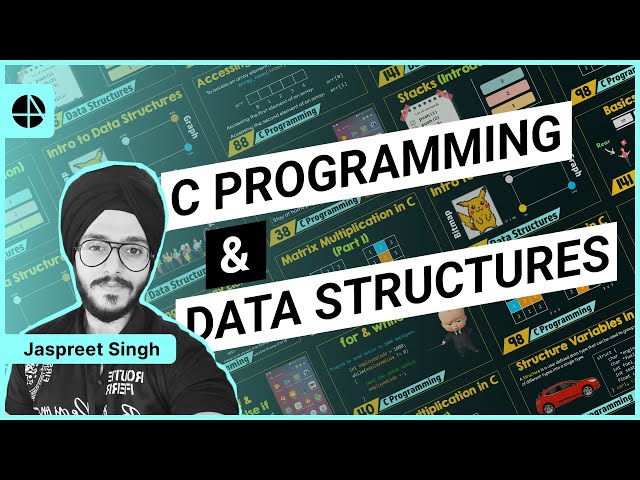
C Programming and Data Structures
Automatically move to the next video in the Classroom when playback concludes
- 1 Introduction to Programming and Data Structures
- 2 C Programming – Features & The First C Program
- 3 Introduction to Variables
- 4 Variable Naming Conventions
- 5 Basic Output Function – printf
- 6 Fundamental Data Types − Integer (Part 1)
- 7 Fundamental Data Types − Integer (Part 2)
- 8 Exceeding The Valid Range of Data Types
- 9 Fundamental Data Types − Character
- 10 Fundamental Data Types − Float, Double & Long Double
- 11 C Programming (Important Questions Set 1)
- 12 Scope of Variables - Local vs Global
- 13 Variable Modifiers − Auto & Extern
- 14 Variable Modifiers − Register
- 15 Variable Modifiers − Static
- 16 Constants in C (Part 1)
- 17 Constants in C (Part 2)
- 18 C Programming (Important Questions Set 2)
- 19 Basic Input Function – scanf
- 20 C Programming (Important Questions Set 3)
- 21 Introduction to Operators in C
- 22 Arithmetic Operators in C
- 23 Increment and Decrement Operators in C (Part 1)
- 24 Increment and Decrement Operators in C (Part 2)
- 25 Relational Operators in C
- 26 Logical Operators in C
- 27 Bitwise Operators in C (Part 1)
- 28 Bitwise Operators in C (Part 2)
- 29 Bitwise Operators in C (Part 3)
- 30 Bitwise Operators in C (Part 4)
- 31 Assignment Operators in C
- 32 Conditional Operator in C
- 33 Comma Operator in C
- 34 Precedence and Associativity of Operators
- 35 Operators in C (Solved Problem 1)
- 36 Operators in C (Solved Problem 2)
- 37 C Programming (Rapid Fire Quiz-1)
- 38 Conditionals (if-else, Nested if and else if)
- 39 Conditionals (Switch)
- 40 for and while Loops
- 41 do-while Loop
- 42 Loop Control Statements − break and continue
- 43 Conditionals and Loops (Solved Problem 1)
- 44 Conditionals and Loops (Solved Problem 2)
- 45 Conditionals and Loops (Solved Problem 3)
- 46 Conditionals and Loops (Solved Problem 4)
- 47 Conditionals and Loops (Solved Problem 5)
- 48 Special Programs in C − Pyramid of Stars
- 49 Special Programs in C − Check If The Number Is Palindrome Number
- 50 Special Programs in C− Check If The Number Is Armstrong Number
- 51 Special Programs in C− Check If The Number Is Strong Number
- 52 Special Programs in C − Check If The Number Is Prime Number
- 53 Special Programs in C − Adding Two Numbers Without Using The Plus Operator
- 54 Special Programs in C − Adding Two Numbers Without Using The Plus Operator (Half Adder Method)
- 55 Special Programs in C − Fibonacci Series
- 56 Special Programs in C − Floyd's Triangle
- 57 Special Programs in C − Binary to Decimal Conversion
- 58 Special Programs in C − Calculating Power of an Integer
- 59 Special Programs in C − Check Leap Year
- 60 Special Programs in C − Check If The Number Is Perfect Number
- 61 Introduction to Functions in C
- 62 Function Declaration in C
- 63 Function Definition in C
- 64 Call By Value & Call By Reference in C
- 65 Functions (Solved Question 1)
- 66 Functions (Solved Question 2)
- 67 Functions (Solved Question 3)
- 68 Static Functions in C
- 69 Static and Dynamic Scoping (Part-1)
- 70 Static and Dynamic Scoping (Part-2)
- 71 Static and Dynamic Scoping (Part-3)
- 72 Static and Dynamic Scoping (Part-4)
- 73 Static and Dynamic Scoping (Solved Question 1)
- 74 Static and Dynamic Scoping (Solved Question 2)
- 75 Recursion in C
- 76 How to write Recursive Functions
- 77 Types of Recursion (Part 1) | Direct & Indirect Recursion
- 78 Types of Recursion (Part 2) | Tail & Non-tail Recursion
- 79 Advantage and Disadvantage of Recursion
- 80 Recursion (Solved Problem 1)
- 81 Recursion (Solved Problem 2)
- 82 Recursion (Solved Problem 3)
- 83 Recursion (Solved Problem 4)
- 84 Recursion (Solved Problem 5)
- 85 C Programming (Rapid Fire Quiz-2)
- 86 Definition of Array
- 87 Declaration of Array
- 88 Accessing Array Elements
- 89 Initializing an Array
- 90 Designated Initialization of Arrays
- 91 Arrays in C (Solved Problem 1)
- 92 Arrays in C (Solved Problem 2)
- 93 Counting Array Elements using sizeof() Operator
- 94 Introduction to Multidimensional Arrays
- 95 Introduction to Two-Dimensional (2D) Arrays
- 96 Introduction to Three-Dimensional (3D) Arrays
- 97 Multidimensional Arrays (Solved Problem)
- 98 C Program for Matrix Multiplication (Part 1)
- 99 C Program for Matrix Multiplication (Part 2)
- 100 Constant Arrays in C
- 101 Variable Length Arrays in C
- 102 Introduction to Pointers in C
- 103 Declaring & Initializing Pointers in C
- 104 Value of Operator in Pointers
- 105 Pointer Assignment
- 106 Pointer Application (Finding the Largest & Smallest Elements in an Array)
- 107 Returning Pointers
- 108 Pointers (Important Questions)
- 109 Pointer Arithmetic (Addition)
- 110 Pointer Arithmetic (Subtraction)
- 111 Pointer Arithmetic (Increment & Decrement)
- 112 Pointer Arithmetic (Comparing the Pointers)
- 113 Pointers (Program 1) | Sum of Array Elements using Pointers
- 114 Using Array Name as a Pointer
- 115 Pointers (Program 2) | Reversing a Series of Numbers using Pointers
- 116 Passing Array as an Argument to a Function
- 117 Using Pointers to Print 2D Arrays
- 118 Processing the Multidimensional Array Elements (or) Address Arithmetic of Multidimensional Arrays
- 119 Pointers (Program 3)
- 120 Pointers (Program 4)
- 121 Pointer Pointing to an Entire Array
- 122 Pointer Pointing to an Entire Array (Solved Problem)
- 123 Pointers (Program 5)
- 124 Pointers (Program 6)
- 125 Pointers (Program 7)
- 126 Pointers (Program 8)
- 127 Pointers (Program 9)
- 128 Basics of String Literals
- 129 Storing the String Literals
- 130 Performing Operations on String Literals
- 131 String Literal vs. Character Constant
- 132 Declaring and Initializing String Variables
- 133 Writing Strings using printf and puts Functions
- 134 Reading Strings using scanf and gets Functions
- 135 Designing The Input Function using getchar()
- 136 putchar() Function in C
- 137 Strings (Solved Problem 1)
- 138 C String Library and String Copy Function - strcpy()
- 139 String Length Function - strlen()
- 140 String Concatenate Functions - strcat() & strncat()
- 141 String Comparison Function - strcmp()
- 142 Array of Strings
- 143 Strings (Solved Problem 2)
- 144 Strings (Solved Problem 3)
- 145 Strings (Solved Problem 4)
- 146 Strings (Solved Problem 5)
- 147 Strings (Solved Problem 6)
- 148 Function Pointers in C
- 149 Application of Function Pointers in C
- 150 Introduction to Structures in C
- 151 Declaring Structure Variables
- 152 Structure Types (Using Structure Tags)
- 153 Structure Types (Using typedef)
- 154 Initializing & Accessing the Structure Members
- 155 Designated Initialization in Structures
- 156 Declaring an Array of Structure
- 157 Pointer to Structure Variable
- 158 Structure Padding in C
- 159 Structure Packing in C
- 160 Structures in C (Solved Problem 1)
- 161 Structures in C (Solved Problem 2)
- 162 Structures in C (Solved Problem 3)
- 163 Introduction to Unions in C
- 164 Unions in C (Solved Problem 1)
- 165 Application of Unions (Part 1)
- 166 Application of Unions (Part 2)
- 167 Enumerations in C
- 168 Program to Find Area of Rectangle Using Structures
- 169 Structures & Unions in C (Solved Problem)
- 170 File Handling | Chapter-14 | C Programming | nesoacademy.org
- 171 Introduction to Data Structures
- 172 Data Types vs. Abstract Data Types
- 173 Data Structure Definition & Advantages
- 174 Types of Data Structures
- 175 Basics of Asymptotic Analysis (Part 1)
- 176 Basics of Asymptotic Analysis (Part 2)
- 177 Basics of Asymptotic Analysis (Part 3)
- 178 Basics of Asymptotic Analysis (Part 4)
- 179 Basics of Asymptotic Analysis (Part 5)
- 180 Guidelines for Asymptotic Analysis (Part 1)
- 181 Guidelines for Asymptotic Analysis (Part 2)
- 182 Asymptotic Analysis (Solved Problem 1)
- 183 Asymptotic Analysis (Solved Problem 2)
- 184 Asymptotic Analysis (Solved Problem 3)
- 185 Understanding the Void Pointers
- 186 Understanding the Null Pointers
- 187 Understanding the Dangling Pointers
- 188 Understanding the Wild Pointers
- 189 Basics of Dynamic Memory Allocation
- 190 Dynamic Memory Allocation using malloc()
- 191 Dynamic Memory Allocation using calloc()
- 192 Dynamic Memory Allocation using realloc()
- 193 Releasing the Dynamically Allocated Memory using free()
- 194 Structures and Functions (Part 1)
- 195 Structures and Functions (Part 2)
- 196 Structures and Functions (Part 3)
- 197 Structures and Functions (Part 4)
- 198 Structures and Functions (Part 5)
- 199 Structures and Functions (Part 6)
- 200 Self Referential Structures
- 201 Introduction to Linked List
- 202 Array vs. Single Linked List (In Terms of Representation)
- 203 Creating the Node of a Single Linked List
- 204 Creating a Single Linked List (Part 1)
- 205 Creating a Single Linked List (Part 2)
- 206 Traversing a Single Linked List (Counting the Nodes)
- 207 Traversing a Single Linked List (Printing the Data)
- 208 Traversing the List (Linked List vs. Arrays)
- 209 Single Linked List (Inserting a Node at the End)
- 210 Insertion at the End (Linked List vs. Array) - Part 1
- 211 Insertion at the End (Linked List vs. Array) - Part 2
- 212 Single Linked List (Inserting a Node at the Beginning)
- 213 Inserting the Data at the Beginning of Single Linked Lists (Possible Mistake)
- 214 Inserting the Data at the Beginning of Single Linked List (2nd Method)
- 215 Inserting the Data at the Beginning (Singly Linked List vs. Array)
- 216 Single Linked List (Inserting a Node at a Certain Position)
- 217 Insertion at a Certain Position (Singly Linked List vs. Arrays) - Part 1
- 218 Insertion at a Certain Position (Singly Linked List vs. Arrays) - Part 2
- 219 Single Linked List (Deleting the First Node)
- 220 Single Linked List (Deleting the Last Node)
- 221 Single Linked List (Deleting the Last Node using Single Pointer)
- 222 Deletion at the End (Singly Linked List vs. Array)
- 223 Deletion at the Beginning (Single Linked List vs. Array)
- 224 Single Linked List (Deleting the Node at a Particular Position)
- 225 Deleting the Entire Single Linked List
- 226 Reverse a Single Linked List
- 227 Singly Linked List (Solved Problem 1)
- 228 Singly Linked List (Solved Problem 2)
- 229 Singly Linked List (Solved Problem 3)
- 230 Singly Linked List (Solved Problem 4)
- 231 Singly Linked List (Solved Problem 5)
- 232 Singly Linked List (Solved Problem 6)
- 233 Rapid Fire Quiz (Singly Linked List)
- 234 Introduction to Doubly Linked List
- 235 Doubly Linked List (Inserting a Node in an Empty List)
- 236 Doubly Linked List (Insertion at the Beginning)
- 237 Doubly Linked List (Insertion at the End)
- 238 Doubly Linked List (Insertion between the Nodes) - Part 1
- 239 Doubly Linked List (Insertion between the Nodes) - Part 2
- 240 Creating an Entire Doubly Linked List
- 241 Doubly Linked List (Deleting the First Node)
- 242 Doubly Linked List (Deleting the Last Node)
- 243 Doubly Linked List (Deleting the Intermediate Node)
- 244 Reversing the Doubly Linked List
- 245 Doubly Linked List (Solved Problem 1)
- 246 Doubly Linked List (Solved Problem 2)
- 247 Why Doubly Linked List?
- 248 Rapid Fire Quiz (Doubly Linked List)
- 249 Introduction to Circular Linked List
- 250 Circular Singly Linked List (Insertion at the Beginning)
- 251 Traversing a Circular Singly Linked List
- 252 Circular Singly Linked List (Insertion at the End)
- 253 Circular Singly Linked List (Insertion between the Nodes)
- 254 Creating a Circular Singly Linked List
- 255 Circular Singly Linked List (Deleting the First Node)
- 256 Circular Singly Linked List (Deleting the Last Node)
- 257 Circular Singly Linked List (Deleting the Intermediate Node)
- 258 Circular Singly Linked List (Counting the Number of Elements)
- 259 Circular Singly Linked List (Searching an Element)
- 260 Circular Doubly Linked List (Insertion at the Beginning)
- 261 Circular Doubly Linked List (Insertion at the End)
- 262 Circular Doubly Linked List (Insertion between the Nodes)
- 263 Circular Doubly Linked List (Deleting the First Node)
- 264 Circular Doubly Linked List (Deleting the Last Node)
- 265 Circular Doubly Linked List (Deleting the Intermediate Node)
- 266 Sorted Singly Linked List (Inserting a New Element)
- 267 Application of Linked List (Polynomial Arithmetic) - Part 1
- 268 Application of Linked List (Polynomial Arithmetic) - Part 2
- 269 Application of Linked List (Addition of Two Polynomials)
- 270 Application of Linked List (Multiplication of Two Polynomials)
- 271 Application of Linked List (Multiplication of Two Polynomials) - Improvements
- 272 Adding Two Numbers using Linked Lists - Part 1
- 273 Adding Two Numbers using Linked Lists - Part 2
- 274 Adding Two Numbers using Linked Lists - Part 3
- 275 Introduction to Stacks
- 276 Array Implementation of Stacks (Part 1)
- 277 Array Implementation of Stacks (Part 2)
- 278 Array Implementation of Stacks (Part 3)
- 279 Array Implementation of Stacks (Part 4)
- 280 Stacks (Important Questions) – Set 1
- 281 Stacks (Important Questions) – Set 2
- 282 Stacks (Program 1) – Part 1
- 283 Stacks (Program 1) – Part 2
- 284 Stacks (Program 1) – Part 3
- 285 Stacks (Program 2) – Part 1
- 286 Stacks (Program 2) – Part 2
- 287 Stacks (Program 3)
- 288 Linked List Implementation of Stacks (Part 1)
- 289 Linked List Implementation of Stacks (Part 2)
- 290 Linked List Implementation of Stacks (Part 3)
- 291 Stacks (Program 4) – Part 1
- 292 Stacks (Program 4) – Part 2
- 293 Stacks (Program 4) – Part 3
- 294 Stacks (Program 4) – Part 4
- 295 Stacks (Program 4) – Part 5
- 296 Stacks (Program 4) – Part 6
- 297 Stacks (Program 4) – Part 7
- 298 Stacks (Program 5)
- 299 Application of Stacks (Nested Brackets) - Part 1
- 300 Application of Stacks (Nested Brackets) - Part 2
- 301 Application of Stacks (Infix to Postfix) - Part 1
- 302 Application of Stacks (Infix to Postfix) - Part 2
- 303 Application of Stacks (Infix to Postfix) - Part 3
- 304 Application of Stacks (Infix to Postfix) - Part 4
- 305 Application of Stacks (Infix to Postfix) - Part 5
- 306 Application of Stacks (Infix to Postfix) - Part 6
- 307 Application of Stacks (Infix to Postfix) - Part 7
- 308 Application of Stacks (Infix to Postfix) - Part 8
- 309 Stacks (GATE Problems) - Set 1
- 310 Stacks (GATE Problems) - Set 2
- 311 Queues | Chapter-7 | Data Structures | nesoacademy.org
- 312 Binary Trees | Chapter-8 | Data Structures | nesoacademy.org
- 313 Binary Search Trees | Chapter-9 | Data Structures | nesoacademy.org
- 314 AVL Trees | Chapter-10 | Data Structures | nesoacademy.org

