Courses from 1000+ universities
Buried in Coursera’s 300-page prospectus: two failed merger attempts, competing bidders, a rogue shareholder, and a combined market cap that shrank from $3.8 billion to $1.7 billion.
600 Free Google Certifications
Greening the Economy: Sustainable Cities
Introduction to Graphic Illustration
Computational Social Science Methods
Organize and share your learning with Class Central Lists.
View our Lists Showcase
Discover a deep learning framework using reinforcement learning to solve high-dimensional partial integro-differential equations, overcoming traditional computational limitations.
Explore simplicial topology's connections to braids, knots, and homotopy groups, plus GLMY theory applications in molecular biology, diseases, materials, and complex networks.
Explore mapping class groups of 4-manifolds using configuration space invariants, including proofs about surface cross 2-sphere groups and connections to Gabai's lightbulb theorem.
Explore advanced reinforcement learning for constrained Markov decision processes with optimal problem-dependent guarantees and novel primal-space algorithms.
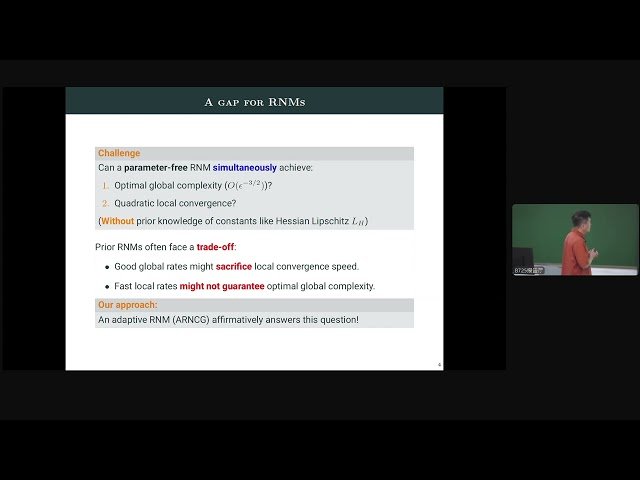
Discover an adaptive regularized Newton-CG method achieving optimal O(ε^-3/2) global complexity while maintaining quadratic local convergence for nonconvex optimization problems.
Explore the geometrization of Hecke algebras through Hecke categories and their (co)center, with applications to Chavelley restriction theorem for reductive algebraic groups.
Explore the interplay between mathematical structure and computational methods through algebraic Riccati equations in this advanced seminar.
Explore how quantum groupoids emerge from quantum group dynamics through operator algebras, investigating quantum symmetries and their role in noncommutative geometry.
Explore derived equivalences in algebraic geometry through invariant theory, focusing on homological algebra and category theory applications to study varieties with insights from physics and noncommutative algebra.
Explore noncommutative geometry on the Berkovich projective line, focusing on representation theory of groups acting on R-trees and the construction of cross-product C*-algebras and KMS states.
Explore the mathematical study of ordering points in space based on their distances from vantage points, featuring an extension of sign pattern results with applications in discrete mathematics and computer science.
Explore noncommutative functional inequalities and their applications to the quantum KKL-conjecture, including Poincare, log-Sobolev, and Talagrand inequalities, with focus on recent advancements.
Explore bimodule quantum Markov semigroups and their symmetry-preserving dynamics through von Neumann algebras, equilibrium states, and functional inequalities.
Explore the spread approximation method and its applications to intersection problems in combinatorics, including recent results on spanning trees, permutations, and forbidden sunflowers.
Explore knot theory and its applications in data analysis with Professor Fengchun Lei, covering 3-manifold topology and topological data analysis concepts in this BIMSA Member Seminar.
Get personalized course recommendations, track subjects and courses with reminders, and more.