Completed
00:03:40 Symptoms start appearing When the valve orifice is reduced to less than 2 cm square. The disease is considered moderately severe at an approximately 1.5 cm square orifice. The leaflets becom…
Class Central Classrooms beta
YouTube videos curated by Class Central.
Classroom Contents
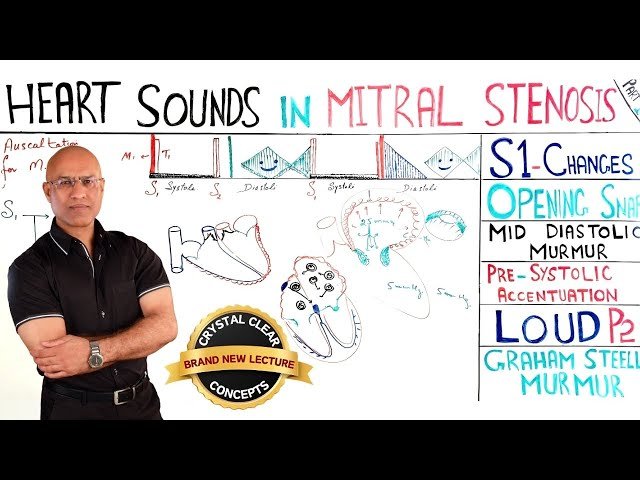
Heart Sounds and Clinical Manifestations in Mitral Stenosis - Session 1
Automatically move to the next video in the Classroom when playback concludes
- 1 00:00:00 Introduction to Lecture: How are heart sounds altered in Mitral Stenosis?
- 2 00:00:05 Changes of S1 in MS: Early stage: Loud
- 3 00:00:15 Why is S1 loud?
- 4 00:00:38 Mechanism of progressive leaflet calcification in Mitral Stenosis.
- 5 00:01:10 Narrowing of the orifice: Fish mouth deformity/ Buttonhole deformity
- 6 00:03:20 Stenotic Valve
- 7 00:03:40 Symptoms start appearing When the valve orifice is reduced to less than 2 cm square. The disease is considered moderately severe at an approximately 1.5 cm square orifice. The leaflets becom…
- 8 00:05:00 Changes in S1 due to valve changes
- 9 00:09:25 S1 genesis in normal healthy individuals
- 10 00:10:15 S1 genesis in Mitral Stenosis
- 11 00:11:55 Quick Recap: Why is S1 loud in Mitral Stenosis?
- 12 00:13:00 Example: A normal mitral valve can be compared to a thin, pliable door that is slightly open and closes gently under minimal pressure. In contrast, a stenotic mitral valve is like a thick, w…
- 13 00:13:50 Advanced Mitral Stenosis: Soft S2 mechanism
- 14 00:15:36 Mitral Stenosis with A-fibrillation
- 15 00:16:45 Normal Conduction System
- 16 00:18:05 Conduction System in Mitral Stenosis
- 17 00:20:30 Thromboembolism mechanism in Mitral Stenosis
- 18 00:23:00 Mechanism of beat-to-beat intensity variation in Mitral Stenosis
- 19 00:25:00 Quick Recap: Mechanism of beat-to-beat intensity variation in Mitral Stenosis
- 20 00:26:20 Quick Recap: Changes in S1 in Mitral Stenosis
- 21 00:28:10 Overview of next lecture: Opening snap, Mid-Diastolic Murmur, Pre-Systolic Accentuation

