Completed
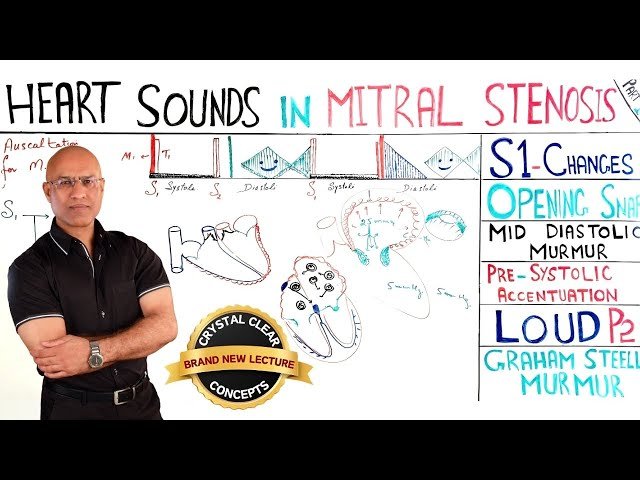
00:00:00 Introduction to Lecture: How are heart sounds altered in Mitral Stenosis?
Class Central Classrooms beta
YouTube videos curated by Class Central.
Classroom Contents
Heart Sounds and Clinical Manifestations in Mitral Stenosis - Session 1
Automatically move to the next video in the Classroom when playback concludes
- 1 00:00:00 Introduction to Lecture: How are heart sounds altered in Mitral Stenosis?
- 2 00:00:05 Changes of S1 in MS: Early stage: Loud
- 3 00:00:15 Why is S1 loud?
- 4 00:00:38 Mechanism of progressive leaflet calcification in Mitral Stenosis.
- 5 00:01:10 Narrowing of the orifice: Fish mouth deformity/ Buttonhole deformity
- 6 00:03:20 Stenotic Valve
- 7 00:03:40 Symptoms start appearing When the valve orifice is reduced to less than 2 cm square. The disease is considered moderately severe at an approximately 1.5 cm square orifice. The leaflets becom…
- 8 00:05:00 Changes in S1 due to valve changes
- 9 00:09:25 S1 genesis in normal healthy individuals
- 10 00:10:15 S1 genesis in Mitral Stenosis
- 11 00:11:55 Quick Recap: Why is S1 loud in Mitral Stenosis?
- 12 00:13:00 Example: A normal mitral valve can be compared to a thin, pliable door that is slightly open and closes gently under minimal pressure. In contrast, a stenotic mitral valve is like a thick, w…
- 13 00:13:50 Advanced Mitral Stenosis: Soft S2 mechanism
- 14 00:15:36 Mitral Stenosis with A-fibrillation
- 15 00:16:45 Normal Conduction System
- 16 00:18:05 Conduction System in Mitral Stenosis
- 17 00:20:30 Thromboembolism mechanism in Mitral Stenosis
- 18 00:23:00 Mechanism of beat-to-beat intensity variation in Mitral Stenosis
- 19 00:25:00 Quick Recap: Mechanism of beat-to-beat intensity variation in Mitral Stenosis
- 20 00:26:20 Quick Recap: Changes in S1 in Mitral Stenosis
- 21 00:28:10 Overview of next lecture: Opening snap, Mid-Diastolic Murmur, Pre-Systolic Accentuation

