Courses from 1000+ universities
17 years ago, Krishna Kumar started offering free PMP prep online. Today, it’s a leading digital upskilling platform that helps millions upskill in AI, cybersecurity, data science, and more.
600 Free Google Certifications
Fundamentals of Neuroscience, Part 1: The Electrical Properties of the Neuron
Organic Chemistry 1
Mountains 101
Organize and share your learning with Class Central Lists.
View our Lists Showcase
Explore sulfur chemistry and aerosol-cloud interactions in volcanic degassing, focusing on Taal volcano's SO2 emissions and their impact on cloud formation, radiation, and atmospheric processes.
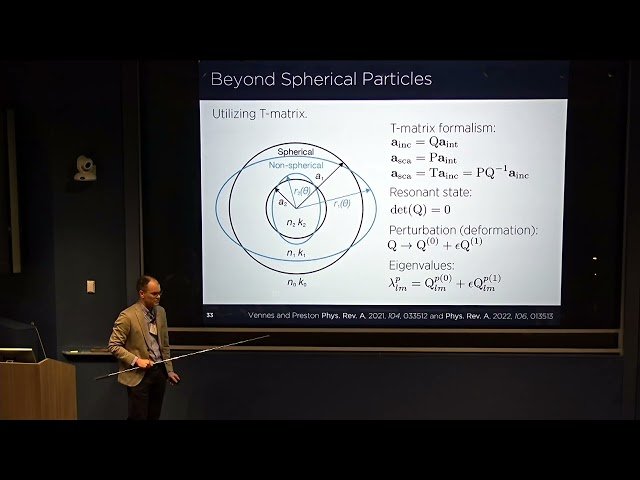
Explore how single-particle trapping and spectroscopy evaluate aerosol materials for solar radiation management, including sulfate, diamond, and metal-oxide particles under various conditions.
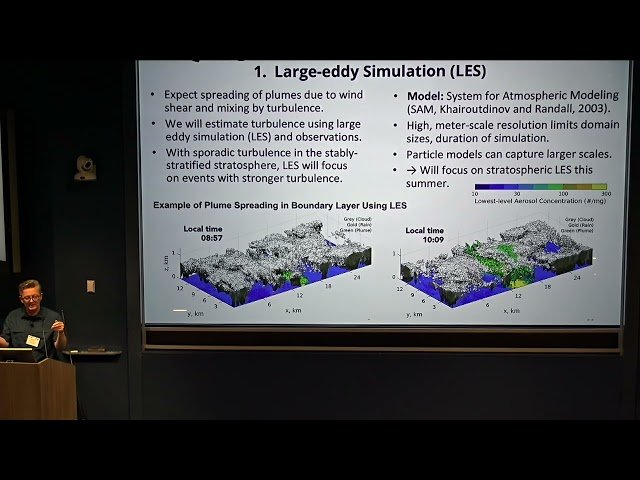
Explore the modeling of atmospheric turbulence for stratospheric aerosol injection, examining how turbulence affects plume evolution and impacts climate cooling strategies and potential side effects.
Explore the mathematical analysis of multi-dimensional compressible Euler equations, focusing on shock formation, maximal hyperbolic development, and the geometric framework for acoustic characteristic surfaces.
Dive into the formulation of a linear model for fluid turbulence, exploring transport phenomena in Fourier space that generate irregular velocity fields from smooth ingredients through energy cascade across scales.
Delve into the propagation of Gaussianity in Hamiltonian equations, focusing on incompressible Euler dynamics and exploring how Gaussian initial data maintains Wick formula properties in large box regimes.
Explore rigorous approaches to wave turbulence in water wave systems, focusing on quasilinear equations and new strategies combining deterministic energy estimates with dispersive propagation of randomness.
Explore how turbulent cascades can be harnessed to generate patterns, with a focus on odd viscosity's role in creating tunable wavelength patterns in chiral fluids from bioactive to quantum systems.
Explore the analytical approach to turbulence statistics using functional renormalization group, examining space-time correlation functions in Navier-Stokes equations and related simplified models like Kraichnan's model and stochastic Burgers equation.
Discover the dynamics of contemporary evolution through a 40-year study of Darwin's finches in the Galápagos, revealing how one species diversified into 18+ species over a million years.
Delve into the derivation of macroscopic equations from microscopic principles in Hilbert's sixth problem, examining both particle systems and wave turbulence through recent research on hard sphere models and nonlinear Schrödinger equations.
Discover how multi-stage neural networks can achieve machine precision for scientific problems, overcoming traditional accuracy limitations and addressing spectral bias in multiscale dynamics and fluid dynamics.
Explore how extreme-scale computation bridges particle physics to nuclear physics, including first-principles nuclear reaction calculations and new insights into proton pressure distribution.
Explore persistent homology of function spaces, geometric metaphors in biology, and mathematical insights from biochemistry, including solutions to Gromov's problem and reflections on landscape and network concepts.
Explore complex discrete probability models in evolutionary biology, focusing on species phylogeny reconstruction from genomic data and the mathematical analysis of discordant gene histories.
Get personalized course recommendations, track subjects and courses with reminders, and more.